
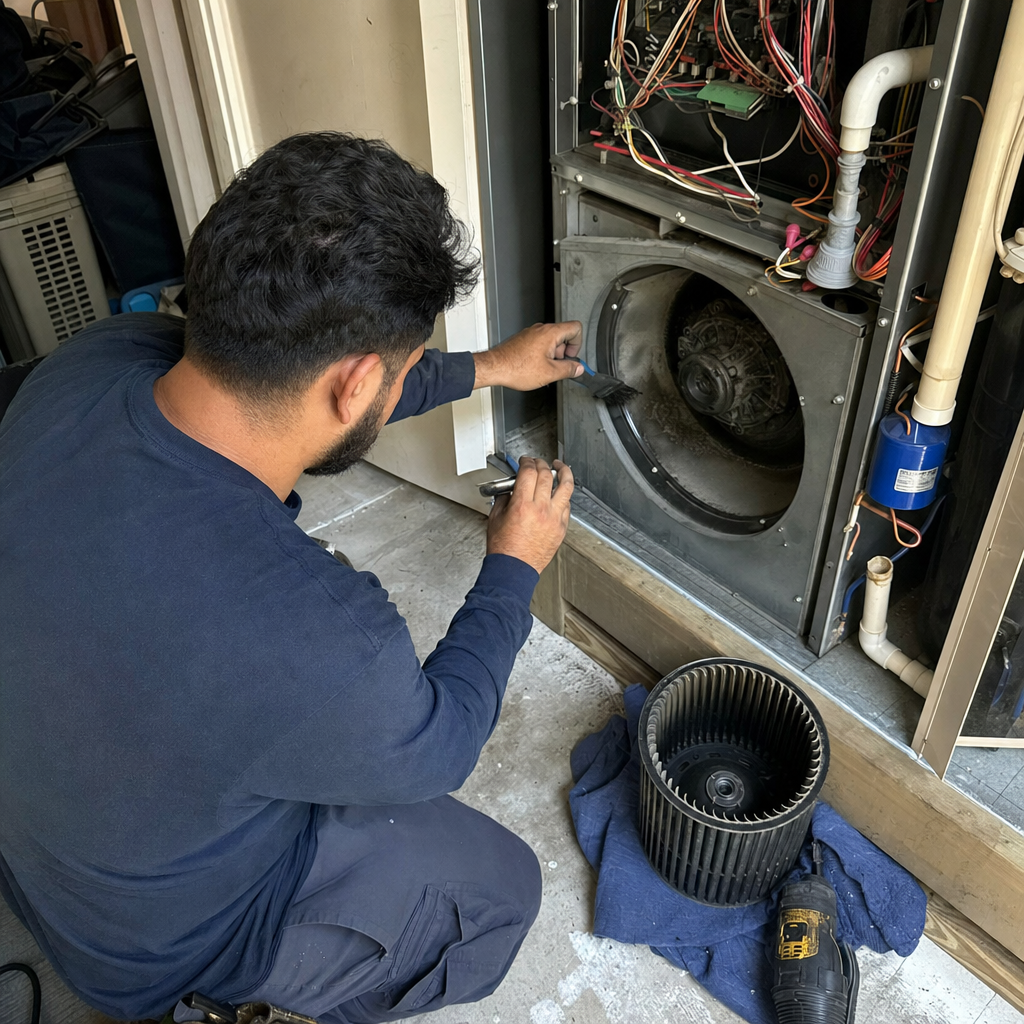
Honeywell Vent Sanitizing: The Texas Owner’s Guide
We stock and install Honeywell-compatible vent sanitizing systems across Texas, with most residential jobs running between $340 and $620 installed, depending on duct configuration and whether your system uses the UV or ionization series. We carry the common Honeywell replacement cartridges and ballast assemblies on our trucks, and we can usually get to you same day if you call before noon. Most Texas homeowners figure out something’s wrong when they notice the musty smell returning right after what they thought was a clean cycle, or when their Honeywell indicator light stays red even with a fresh filter.
Which Honeywell Models This Applies To
Honeywell has sold vent sanitizing equipment under a few different series names over the years, and the part you need depends on which generation is mounted in your plenum or return air cabinet. The current residential line is the Honeywell Home UV Air Purifier series, including the UV100A, UV100E, and the newer UV2400U models. The commercial-grade Air Knight and Reme Halo units are sometimes confused with Honeywell because they were co-labeled through distributor partnerships in the 2010s, but they use entirely different mounting brackets and voltage specs.
To identify yours, look for the silver data plate on the ballast housing, usually on the side facing the blower compartment. The part number starts with UV or AP, followed by the series digits. The critical compatibility gotcha in Texas is voltage: older Honeywell UV systems ran on 120V, but models manufactured after 2018 switched to 24V to integrate with smart thermostats. Swapping a 120V ballast into a 24V control circuit will fry the board. We see this mistake in DIY replacements around Frisco and Plano more often than you’d think.
We source OEM Honeywell lamps and cartridges, but we also stock quality aftermarket equivalents from Lennox, Trane, and Carrier that cross-reference to the same germicidal UV-C spec of 253.7 nanometers. The aftermarket lamps typically carry the same 9,000-hour rated life, though we’ve found the OEM Honeywell quartz sleeves hold up better in Texas attics where summer ambient temperatures spike past 140°F. We’ll show you both options and the price difference before we open the duct.
Signs Your Honeywell Vent Sanitizing Is Failing
- The indicator light is out or flashing red. Honeywell UV ballasts use a simple LED circuit to confirm lamp ignition. A steady green means the lamp is drawing proper current and producing UV-C. Flashing red usually means the lamp has reached end of life or the ballast cannot maintain the 800-milliamp strike voltage. In Texas, we see premature ballast failure when attic-installed units cook through July and August without proper plenum insulation.
- You smell mildew or “old sock” odor from vents, especially after rain. A working UV system suppresses mold and bacterial growth on the evaporator coil and in the drain pan. When the lamp fails, that biological film re-establishes within 48 to 72 hours in our humid Gulf Coast and East Texas climate zones. The smell is your first warning before visible mold appears.
- Higher-than-normal electric bills with no change in thermostat setting. A fouled evaporator coil from failed sanitizing forces your compressor to run longer to hit temperature. We’ve measured 12% to 18% efficiency drops in homes around Houston where the UV lamp had been dark for two seasons.
- Visible dust accumulation on supply registers despite regular filter changes. This points to the ionization side of combination units, like the older Honeywell F300 Electronic Air Cleaner with UV add-on. When the ionizing wires lose charge, particulate passes through to the ductwork and settles at the termination points.
- The lamp looks purple through the viewport, but faint or flickering. UV-C is invisible, but the lamp also produces a small amount of visible violet light. A strong, steady glow suggests full output. Flickering or dim violet means the mercury amalgam is degrading, and output has likely fallen below the effective sterilization threshold of 40 microwatts per square centimeter at one meter.
Replacement Cost & What’s Included
For a standard Honeywell UV lamp and ballast replacement in a Texas residential system, our installed pricing runs:
| UV lamp replacement only (OEM) | $180 - $260 |
| UV lamp replacement only (quality aftermarket) | $140 - $200 |
| Ballast + lamp replacement | $340 - $480 |
| Full sanitizing system upgrade (new mount, lamp, ballast) | $520 - $620 |
| Combination UV + ionization retrofit | $780 - $940 |
What drives the range is access. A Honeywell unit mounted in an open basement plenum in Dallas takes twenty minutes. The same unit buried in a sealed closet return in a 1980s Richardson ranch with limited clearance can run past an hour. Our price includes the pre-work camera inspection, the part, the labor, disposal of the spent lamp (mercury-containing, so we handle that properly), and a post-installation airflow and UV intensity check. Every sanitizing job carries our 90-Day Done Right Promise in writing. If the odor returns or the light throws a code, we come back at no charge. No paperwork, no arguing.
DIY or Call Us?
There’s a safe middle ground here. You can absolutely check your Honeywell indicator light, note the part number from the data plate, and verify whether your breaker labeled “UV” or “Air Cleaner” is tripped. Some homeowners in our Texas market also replace the pre-filter or media filter themselves, which is straightforward.
Where DIY goes wrong is the lamp itself. Germicidal UV lamps contain mercury vapor and operate at high strike voltage, and the quartz sleeve is fragile and easy to crack with bare hands. More importantly, without a UV radiometer, you cannot verify that the new lamp is actually producing sterilizing-level output. We’ve been called to homes in Arlington and Garland where a homeowner installed a “working” lamp that turned out to be a blacklight party bulb from an online marketplace, zero germicidal effect. We don’t use scare tactics, but we do recommend a trained technician for the lamp and ballast work. The part is too specific and the verification too important to guess.
If you’re unsure what you’ve got, call us at (866) 347-2063. We’ll walk you through reading that data plate over the phone, and if you need us out, we’ll show you one honest price before we start.
FAQs
Most Honeywell UV lamps are rated for 9,000 hours of continuous operation, which works out to roughly one year if your HVAC fan runs constantly, or about two years if it cycles with heating and cooling calls. In Texas, we see shorter effective life, about 7,000 to 8,000 hours, because attic heat accelerates electrode degradation. We recommend annual inspection and replacement every 18 months for systems in unconditioned spaces. Call (866) 347-2063 to schedule a check, estimates are free.
Individual components can be repaired in isolation. A failed ballast can be swapped while keeping the lamp housing. A cracked quartz sleeve can be replaced without touching the ballast. However, if the unit is more than ten years old, we usually recommend full replacement because Honeywell changed the mounting footprint in 2016, and future parts availability for pre-2016 housings is shrinking. We’ll show you both paths and the honest math on each. Call (866) 347-2063 for a free estimate.
A straightforward Honeywell UV lamp replacement takes 30 to 45 minutes. A ballast-and-lamp job runs 60 to 90 minutes. Full system upgrades or retrofits into a new plenum location can stretch to three hours, though we complete most jobs in a single visit. We camera-inspect before and after, so you’ll see the difference. Call (866) 347-2063 to book a same-day slot.
We carry the UV100 series lamps, the 24V and 120V ballasts, and the common quartz sleeves on every service vehicle. For the newer UV2400U series or specialized commercial ionization cells, we may need to pull from our Mesquite warehouse or overnight from our distributor, but we can still usually get to you within 24 hours. We don’t send a technician to confirm a part number and leave you waiting, we verify what you need before we dispatch. Call (866) 347-2063 and we’ll sort it out over the phone.
We stand behind it - and around here, that has meant something for a long time. If your Honeywell vent sanitizing system is throwing a code, smelling off, or just due for its annual check, give us a call. We’ll pick up the phone, we’ll show up when we say, and we’ll give you one honest price before we lift a single tool.
Written by Wade Kellerman, Owner, Bellows Air Duct & Vent Co. of Texas at Bellows Air Duct & Vent Co. of Texas, serving Texas and nearby areas.