
Honeywell Dryer Vent Cleaning in Texas: What to Know First
We provide independent Honeywell dryer vent cleaning across Texas, with most jobs scheduled within 24 to 48 hours and completed in a single visit. Our upfront pricing is disclosed before we touch a tool, and every job carries our 90-Day Done Right Promise in writing. If you own a Honeywell dryer or venting system and you’re noticing longer dry times, a hot laundry room, or that burnt-lint smell coming through the utility room, you’re who this page is for. Call us at (866) 347-2063 for a free estimate and we’ll walk you through what we find before we do anything about it.
How Honeywell Products Fail - and How We Fix Them
- HDV Series vent caps with stuck louvers. The HDV line uses lighter-grade plastic louvers that gum up with Texas cotton lint and hard water residue faster than metal alternatives. We see this in Plano and Frisco homes with newer construction where the cap sits on a west-facing wall and bakes in afternoon sun. We clean the assembly, replace the louver kit with a quality aftermarket stainless version if the hinge pins are worn, and verify full closure so wasps don’t move in next spring.
- MV600 and MV800 inline booster fans that quit pulling. These fans are spec’d for longer vent runs common in Texas ranch-style homes with laundry rooms set back from exterior walls. The motor bearings collect lint that bypassed the primary screen, especially in homes with shedding pets or new construction drywall dust. We pull the fan, clean the impeller and housing with a HEPA-contained vacuum, test static pressure with a manometer, and replace only if the amp draw is out of spec. OEM motors run $180-$240; we source the same spec from Fantech if the homeowner prefers.
- Flexible transition ducts behind the dryer. Honeywell’s installation guides allow up to 8 feet of flexible duct, but in Texas heat that foil flex hardens and cracks where it kinks against the wall. We’ve found collapsed sections in Garland and Richardson homes that reduced airflow by half. We replace with rigid aluminum or UL-listed semi-rigid, measured to the inch, and we show you the before-and-after on camera.
- Condensation pooling in low-slope horizontal runs. Honeywell’s venting kits for stackable units often include a 90-degree elbow that traps humid Texas Gulf Coast air. The moisture mixes with lint into a paste that hardens like papier-mache. We see this in Houston-area homes near the Ship Channel where ambient humidity stays above 70 percent for months. We rod out the obstruction, pitch the run back toward code minimums, and install a proper cleanout tee if the geometry allows.
- Bird guard mesh that’s too fine. Honeywell’s OEM bird guards use 1/4-inch mesh that clogs with lint in single-family homes doing more than four loads weekly. We replace with a 3/8-inch stainless guard or a louvered cap with backdraft damper, depending on the local bird pressure. In Waco and Temple, grackles will tear apart anything less substantial, so we anchor accordingly.
Our Honeywell Dryer Vent Cleaning Process
- 1
Call and schedule. A live person answers, 24 hours a day. We ask the model number off your Honeywell dryer’s door frame, the vent run length if you know it, and whether you’ve noticed any symptoms. We quote a range upfront.
- 2
Camera inspection on arrival. Our technician runs a borescope through the full vent run before touching anything. You see what we see on a handheld monitor. This establishes the baseline and protects both of us.
- 3
Diagnosis and parts decision. We identify whether the issue is lint accumulation, mechanical failure, or installation error. If a part needs replacing, we explain OEM versus quality aftermarket options, what each costs, and what the warranty implications are. You decide before we proceed.
- 4
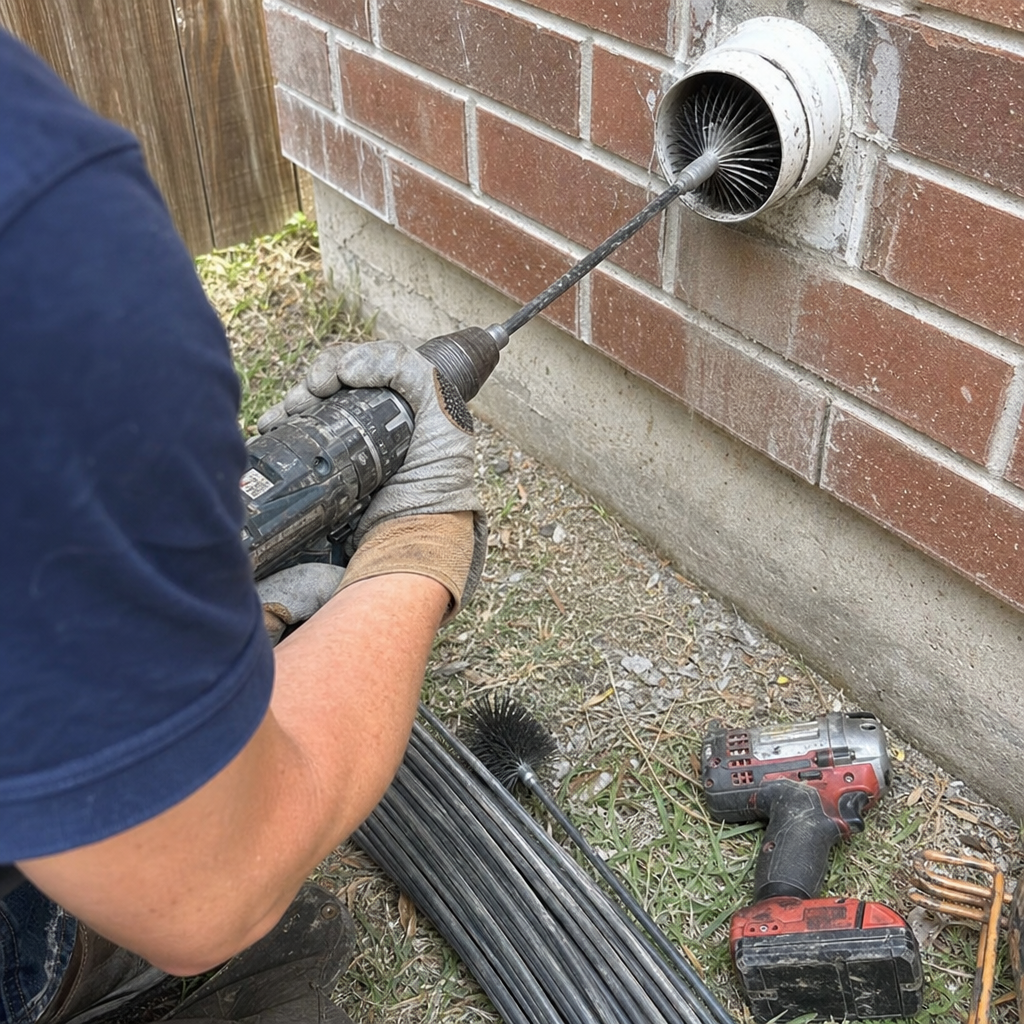
Cleaning and repair. We use Rotobrush and Nikro equipment to agitate and extract lint, then address any mechanical issues. For Honeywell systems, we verify that any replacement components meet the original airflow spec so the dryer’s thermal protection isn’t stressed.
- 5
Post-job camera verification and airflow test. We run the borescope again, measure temperature and velocity at the exterior cap, and show you the comparison. The numbers have to make sense or we don’t leave.
- 6
Written guarantee and cleanup. You get a copy of our 90-Day Done Right Promise, the before-and-after images, and an invoice that matches the quote. We stand behind it - and around here, that has meant something for a long time.
What Honeywell Dryer Vent Cleaning Costs in Texas
Most standard Honeywell dryer vent cleanings in Texas run $149 to $289. Here’s what moves the needle:
- Standard cleaning, single-story, straight run under 15 feet: $149-$189
- Two-story or roof-vented run, or runs over 25 feet: $219-$289
- Booster fan cleaning (MV600/MV800 series): add $75-$125
- Vent cap or bird guard replacement: $45-$95 parts and labor
- Transition duct replacement (rigid aluminum): $65-$125
Longer runs, attic or crawlspace access, and accumulated neglect all add time. We tell you where you land before we start. Estimates are free. Call (866) 347-2063.
Why Texas Homeowners Call Bellows Air Duct & Vent Co. of Texas for Honeywell Work
We’ve been at this since 2012, and Wade Kellerman has spent the better part of three decades doing duct work across the Metroplex after coming up through Eastfield College’s HVAC program in Mesquite. Our technicians are background-checked and uniformed, and they answer to a live person at our office 24 hours a day. We also service Lennox, Trane, and Carrier systems, so if your vent issue connects to a broader HVAC problem, we don’t hand you off to another contractor. The 90-Day Done Right Promise means if it’s not right, we make it right with no paperwork and no arguing. That’s been our way since before “customer service” became a department.
FAQs
No. Routine maintenance and vent cleaning do not void Honeywell’s dryer warranty, provided the work is done by a qualified technician and no original components are modified without equivalent replacement. As an independent Honeywell service provider, we document everything we touch so you have a record if a warranty question ever comes up. Call (866) 347-2063 if you want us to review your specific model’s coverage.
For cosmetic or non-critical components like vent caps and bird guards, quality aftermarket stainless steel parts often outlast OEM plastic and cost 30 to 40 percent less. For inline booster fans and backdraft dampers, we typically recommend OEM or direct-cross equivalents to maintain the airflow curve Honeywell engineered. We explain the trade-off on every part and let you decide before we order anything.
Repair is almost always cheaper if the duct is galvanized steel or aluminum in good structural condition. Replacement makes sense when we find multiple holes, improper slope, or dangerous materials like old foil flex or PVC (which is not code-compliant for dryer venting in Texas). We’ll show you both options with real numbers. Call (866) 347-2063 for a free estimate.
Most Texas appointments are available within 24 to 48 hours, and same-day service is often possible if you call before 10 a.m. We don’t overbook, so when we say we’ll be there, we’ll be there. Emergency calls for suspected blockages or overheating units get priority scheduling.
Yes. We service all major brands including Lennox, Trane, and Carrier, and many Texas homes have mixed systems where the dryer is Honeywell but the HVAC venting connects to another manufacturer’s ductwork. Our technicians carry the tools and training to handle the full stack without calling in a second crew.
Written by Wade Kellerman, Owner, Bellows Air Duct & Vent Co. of Texas at Bellows Air Duct & Vent Co. of Texas, serving Texas and nearby areas.