
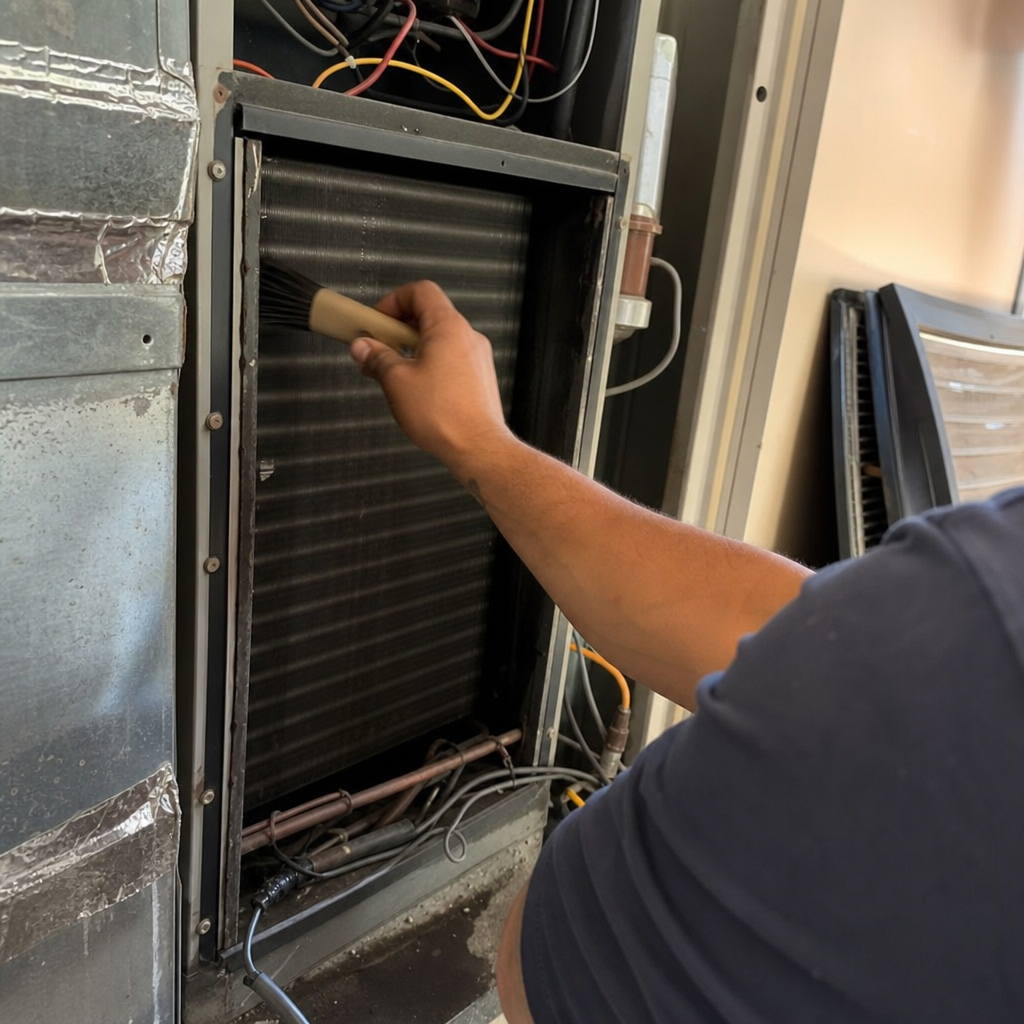
Honeywell Coil Cleaning: The Texas Owner’s Guide
Honeywell coil cleaning in Texas typically runs $340-$580 for a full evaporator or condenser coil service, and we stock the compatible foaming agents, fin combs, and treatment solutions for most Honeywell residential systems on our trucks. Most cleanings are completed same-day, with camera inspection before and after so you see the difference. Homeowners usually figure out something’s wrong when their Honeywell unit runs nonstop through a July afternoon but the house never quite cools down, or they notice a musty smell right when the blower kicks on.
Which Honeywell Models This Applies To
Honeywell doesn’t manufacture complete HVAC systems themselves, but their coil assemblies and air handling components show up in a wide range of matched systems across Texas. We regularly clean Honeywell-branded cased coils in the CHPF, CAPF, and CKPF series, plus the uncased CNPV and CNPFC lines that are common in 2.5-ton to 5-ton residential splits throughout the Metroplex. The critical detail is matching the fin density: Honeywell’s residential coils run 8-14 fins per inch depending on the series, and using the wrong pressure or chemical concentration will flatten those aluminum fins permanently.
To identify your coil, look for the silver label on the front panel of the air handler or the side of the cased coil assembly. The model number will start with those four-letter prefixes. If the label’s faded from attic heat (common in Plano and Frisco homes built in the 2000s), we measure the cabinet dimensions and fin spacing in person. For OEM cleaning agents, we use Honeywell-specified foaming solutions where the application calls for it. For most maintenance cleanings, our professional-grade alkaline foamer from Nikro breaks down Texas pollen and construction dust just as effectively at roughly half the chemical cost. We carry both on the truck and explain which we’re using before we start.
Signs Your Honeywell Coil Cleaning Is Failing
- Ice buildup on the evaporator coil. When the coil can’t exchange heat because of dirt or biological growth, refrigerant temperatures drop below freezing and frost accumulates. In Texas, we see this most in spring when live oak pollen coats the outdoor condenser and homeowners haven’t scheduled their seasonal service yet.
- Weak airflow from vents despite the blower running at full speed. A clogged coil acts like a dirty air filter on the far side of the system, restricting the volume of conditioned air that can reach your rooms. We measure this with a digital manometer and show you the before-and-after pressure readings.
- Musty or sour smell when the system cycles on. Organic growth on a wet coil produces that distinctive locker-room odor, especially in humid months along the Gulf Coast where condensate drains slowly. The smell means the coil needs more than a rinse; it needs antimicrobial treatment.
- Utility bills climbing without thermostat changes. A dirty coil forces the compressor to run longer to achieve the same temperature drop, and in August heat that extra runtime adds up fast. We’ve seen 20-30% spikes in monthly usage that traced directly to neglected coils.
- Water pooling below the air handler. When fins are packed with debris, condensate doesn’t sheet down into the drain pan properly; it drips or overflows instead. In slab-on-grade Texas homes with closet-mounted air handlers, this shows up as stained baseboard or warped flooring.
Replacement Cost & What’s Included
| Service Level | Price Range | What’s Included |
|---|---|---|
| Standard coil cleaning (evaporator or condenser) | $340-$420 | Foaming treatment, fin straightening, drain pan cleaning, camera inspection, 90-Day Done Right Promise |
| Deep restoration cleaning (both coils) | $480-$580 | Full system treatment, antimicrobial application, blower wheel cleaning, before/after video record |
| Coil replacement (if cleaning won’t recover it) | $1,200-$2,400 | New Honeywell-compatible coil, recovery/recharge, pressure testing, written warranty |
What moves the price: accessibility (attic vs. closet vs. rooftop), the degree of fin damage, and whether the coil has been neglected long enough to require acid-based restoration or full replacement. We disclose the exact number before we lift a single tool. No bait coupons, no price changes at the door. Every cleaning carries our 90-Day Done Right Promise - if airflow or temperature split doesn’t measure right, we return at no charge with no paperwork required.
DIY or Call Us?
There’s a safe middle ground here. A homeowner can absolutely rinse the outdoor condenser fins with a gentle hose spray from the outside inward (never pressure-wash; you’ll fold the fins like a deck of cards). You can also keep vegetation trimmed back 18 inches and change filters monthly during pollen season. Where DIY goes wrong is the evaporator coil inside the air handler: it’s energized electrical equipment sitting above a drain pan, often in a hot attic with limited working space. The foaming agents that actually dissolve biological growth are professional-grade and require proper ventilation and rinse protocol. We’ve been called to jobs where a homeowner’s store-bought cleaner corroded the aluminum fins or overflowed the pan into the ceiling below. For the evaporator, or if your condenser hasn’t been cleaned in two-plus Texas summers, it’s worth having us handle it. Call (866) 347-2063 and we’ll give you an upfront price before we schedule.
FAQs
In Texas conditions, a thorough coil cleaning typically stays effective for 12-18 months, though homes near construction or with heavy live oak exposure may need attention every 10-12 months. The standing $89 Seasonal Tune-Up includes coil inspection and light maintenance to extend that interval. Call (866) 347-2063 to schedule.
No - “repair” isn’t the right word for a dirty coil; it’s either cleaned or replaced. If the fins are corroded through or the copper tubing has pinholes from formicary corrosion (common in newer Texas subdivisions with Chinese drywall remnants), replacement is the only option. We camera-inspect first and show you exactly what we’re seeing.
A single-coil cleaning takes 90 minutes to two hours; a full system deep clean runs three to four hours. Most jobs are completed in one visit by a background-checked, uniformed technician. We don’t leave until the airflow numbers make sense.
Yes - we carry foaming agents, fin combs, antimicrobial treatments, and restoration chemicals for Honeywell coils on every service truck, along with Lennox, Trane, and Carrier equivalents. Same-day service is standard across the Metroplex. Call (866) 347-2063 for availability in your area.
We’re an independent service provider - not affiliated with Honeywell - and we’ve been doing this work since 2012. We also stock parts and perform coil cleaning for Lennox, Trane, and Carrier systems. If your Honeywell coil is past cleaning and needs replacement, we’ll match the right aftermarket or OEM component to your system and stand behind the installation with our 90-Day Done Right Promise. We stand behind it - and around here, that has meant something for a long time.
Ready to get your Honeywell system breathing right again? Call (866) 347-2063 for a free estimate. We’ll answer the phone 24 hours a day, give you one honest price before we start, and show you camera proof that the job was done right.
Written by Wade Kellerman, Owner, Bellows Air Duct & Vent Co. of Texas at Bellows Air Duct & Vent Co. of Texas, serving Texas and nearby areas.